

Claude for Outlook is generally available to Pro, Max, Team,
and Enterprise plans.
It is not available on the Free plan. If you connect through a
third-party platform, you can use
the add-in without a Claude account.
What you can do
With Claude for Outlook, you can:- Triage your unread inbox into what needs you, what Claude can handle, and what is noise.
- Draft replies, reply-alls, and forwards, in your voice if you let Claude learn it, landed unsent in Outlook’s compose pane.
- Summarize long threads into decisions made, open items, and who owes what, with per-email citations.
- Read
.docxand.xlsxattachments inline without opening them. - Find meeting times across attendees and draft invites into Outlook’s native appointment form.
- Prep for your next meeting with a one-page brief of recent threads and attached documents.
Get started with Claude for Outlook
Supported versions
Claude for Outlook runs on the following Outlook clients.- Outlook on the web
- Outlook on Windows, both new Outlook and classic Outlook, with a Microsoft 365 subscription
- Outlook on Mac with a Microsoft 365 subscription
Install for yourself
1
Open the marketplace listing
2
Install the add-in
Select “Get it now” to install.
3
Open Claude in Outlook
Open Outlook, then open or select an email. Select the Claude button
and sign in with your Claude account.
- Outlook on the web and new Outlook on Windows: open or select a message, select Apps on its action bar or More apps on the ribbon, then select Claude. To keep Claude on the ribbon and the action bar, select More apps on the ribbon, right-click Claude, and select Pin.
- Classic Outlook on Windows: set the Reading Pane to Right or Bottom in the View tab, because Microsoft states that add-ins are unavailable otherwise. Select a message, then select Claude on the Home tab of the ribbon. If Claude is not there, select All Apps on the ribbon, then select Claude. With the Simplified Ribbon, All Apps is behind the ellipsis button. If the message is open in its own window, look on the ribbon of that window.
- Outlook on Mac: set the Reading Pane to Right or Below in the View menu, because Microsoft states that add-ins are unavailable otherwise. Select a message, then select Claude on the toolbar. If Claude is not there, select the ellipsis button on the toolbar, then select Claude.
Remove the add-in
Where you remove Claude for Outlook depends on your Outlook client. In Outlook on the web and Outlook on Windows, select More Apps on the navigation bar or All Apps on the ribbon, then Add apps. On the Apps page, select Manage your apps, find Claude, and select More options, then Remove. Microsoft’s Use add-ins in Outlook page gives these steps for new Outlook. In classic Outlook, the button after All Apps is Add Apps or Get Add-ins, depending on your version or account type. Get Add-ins opens the Add-Ins for Outlook dialog instead of the Apps page, so remove Claude there. In Outlook on Mac, open the Add-Ins for Outlook dialog in a browser and remove Claude there. If there is no option to remove it, your administrator manages the add-in. Ask them to remove it.Deploy to your organization
Organization admins can deploy Claude for Outlook through the Microsoft 365 Admin Center.1
Open Integrated apps
In the Microsoft 365 Admin Center, go
to Settings, then Integrated apps.
2
Find the add-in
Search for “Claude for Outlook” in Microsoft AppSource.
3
Deploy
Deploy the add-in to your organization or to specific people. See
Microsoft’s deployment guide
for assignment options.
4
Grant Microsoft Graph consent
Complete the Microsoft Graph admin consent
step below so users are not prompted individually.
If your organization uses Microsoft Entra Privileged Identity
Management (PIM) for admin roles, the Integrated apps page does not
recognize roles activated through PIM, so deployment fails. This is a
known Microsoft issue,
tracking ID 11126536. To work around it, deploy from an admin account
with the required role assigned as permanently active rather than
PIM-eligible. See
Microsoft’s troubleshooting guidance.
Individual users can still
install the add-in themselves.
Install from a manifest file
If deploying from the store does not work for your organization, an IT administrator can deploy the add-in by uploading its manifest file directly.1
Download the manifest
Download the
Claude for Outlook manifest
and save it to a secure location.
2
Open Integrated apps
In the Microsoft 365 Admin Center, go
to Settings, then Integrated apps.
3
Upload the add-in
Select Upload custom apps, then Office Add-in. Choose the option to
upload a manifest file from your device, select the file you downloaded,
and upload it.
4
Assign people
Choose your deployment scope: the entire organization, specific
people, specific groups, or just yourself for testing.
5
Deploy
Review the settings and select Finish deployment. The add-in can take
up to 72 hours to appear for everyone, and people may need to restart
Outlook to see it.
6
Grant Microsoft Graph consent
Complete the Microsoft Graph admin consent
step below.
Troubleshoot installation
Find your symptom below.The Claude button is missing after you install
Open or select a message first, then look where your Outlook client puts the button. Install for yourself lists the place for each client. The add-in may not appear right away in desktop Outlook, so restart Outlook if you still do not see the button.”Get it now” does nothing or returns to the same page
Add-ins are installed on a mailbox, not on a device. Sign in to the listing page with the same Microsoft account that you use in Outlook, then select “Get it now” again. If the install still does not complete, your organization may restrict who can install Outlook add-ins. In Exchange Online, the My Marketplace Apps user role controls whether people can install add-ins from the store for themselves. Ask your Microsoft 365 administrator to assign you that role or to deploy Claude for Outlook to your organization.You use a Gmail, Yahoo, iCloud, IMAP, or POP account in Outlook
These accounts are not supported. Claude for Outlook needs a mailbox on Exchange Online, as described in Supported versions.You use a Free Claude account
Claude for Outlook is not available on the Free plan. You can install the add-in, but you cannot finish signing in. After you select “Connect” on the page that opens in your browser, it says which plans include the add-in and links to the upgrade page. The Claude pane keeps showing your sign-in code until it expires. To use Claude for Outlook, upgrade your plan. Then sign in again from the Claude pane: select “Start over” if the code expired, “Continue in browser” if your code still shows, or “Log in”. If you also belong to an organization on a Team or Enterprise plan, you do not need to upgrade. On the page in your browser, select “Try a different account”, choose that organization, and select “Connect” again.Mailbox features are unavailable
Features that look beyond the open email, such as triage, search, and free/busy lookups, need a one-time approval to read your mailbox. If the setup screen says “Your admin needs to approve access”, select “Copy link for your admin” and send the link to your Microsoft 365 administrator. After they approve, select “I’ve been approved”. See Grant Microsoft Graph consent for what the administrator does. If the setup screen says “Your admin needs to grant you access”, your organization requires each person to be assigned to Claude, and you are not assigned yet. Select “Copy request for your admin” and send the text to your Microsoft 365 administrator. After they assign you, select “I’ve been assigned”. You do not have to wait for your administrator. Select “Continue without mailbox access” to use Claude on the email you have open. The other features stay off until your administrator acts. If you already continued, select the warning button in the row with the + button at the message box. It offers the same link or request for your administrator, and Retry for after they act. If the setup screen says “This Outlook client doesn’t support Microsoft Graph sign-in”, approval will not help, because this Outlook client cannot use triage, search, or free/busy lookups. Unless your organization requires a sensitivity label check, reading and drafting on the open email still work, so select “Continue without mailbox access” to keep going. To use those features, update Outlook to a current Microsoft 365 subscription version, or use Outlook on the web. If a screen titled “Can’t check this email’s label” says “This Outlook client doesn’t support Microsoft Graph sign-in”, your organization requires a sensitivity label check that this client cannot run. That screen has no “Continue without mailbox access” option, and Try again will not help. To use Claude on that email, update Outlook or use Outlook on the web.The setup screen says “Couldn’t connect to Microsoft Graph”
This message can mean that access to your mailbox has not been approved yet, or that sign-in failed for another reason. Select Retry, and complete the Microsoft sign-in if a window opens. If the window says “Need admin approval”, your Microsoft 365 administrator needs to approve access for your organization, as described in Grant Microsoft Graph consent. If the screen changes to “Your admin needs to approve access” or “Your admin needs to grant you access”, follow Mailbox features are unavailable. If it still fails, ask your Microsoft 365 administrator whether they have completed Microsoft Graph consent. If the screen shows “Copy error for support”, send them the copied text. To use Claude in the meantime, select “Continue without mailbox access”. Triage, search, and free/busy lookups stay off until the connection works.The Claude pane is blank or does not load
If the pane shows “Claude couldn’t load Office’s add-in library”, your network may be blockingappsforoffice.microsoft.com. Ask your IT
administrator to allow that address, then reopen the pane.
If the pane stays blank, check that your Outlook is one of the
supported versions. Outlook 2016 and 2019 perpetual
or volume-licensed editions can run add-ins in an older browser engine, and
the Claude pane may stay blank there. Update to a current Microsoft 365
subscription version of Outlook, or use Outlook on the web.
Grant Microsoft Graph consent
Claude for Outlook reads mail and calendar data through Microsoft Graph. This needs a one-time grant for your whole tenant, separate from the Integrated apps deployment. A Global Administrator or a Cloud Application Administrator can give it. Have one of them open the following admin consent link in a browser where they are signed in to your Microsoft 365 tenant.Mail.ReadWrite, Calendars.Read, User.Read, and offline_access.
After they select Accept, all users in the organization
can use Claude for Outlook without additional Microsoft prompts. The grant
takes effect immediately. Only the add-in rollout itself can take up to 72
hours.
If this step is skipped, people may see “Your admin needs to approve
access” or “Couldn’t connect to Microsoft Graph” on the Claude setup screen.
If they try again from there, Microsoft may show its own “Need admin
approval” window.
The redirect to pivot.claude.ai after consent carries only the consent
outcome, never a token or authorization code. See
Why sign-in redirects through pivot.claude.ai
for what each redirect carries and how to verify it in a network capture.
Use your own Entra app instead
If your organization’s policy does not permit consenting to a third-party multi-tenant application, register a single-tenant application in the Microsoft Entra admin center and have the add-in use it instead. The data flow is identical; the Graph token stays in the user’s Outlook client either way. The difference is that approval and Conditional Access policy live entirely under an application your organization owns.1
Register the application
In the Entra admin center, go to App registrations and create a new
registration. Choose “Accounts in this organizational directory only”.
2
Configure authentication
Under Authentication, add a Single-page application platform with
redirect URI
brk-multihub://pivot.claude.ai. In Advanced settings,
set “Allow public client flows” to Yes.3
Add Graph permissions
Under API permissions, add the Microsoft Graph delegated permissions
Mail.ReadWrite, Calendars.Read, User.Read, and offline_access.
Select “Grant admin consent” for your tenant.4
Add the client ID to the manifest
Copy the application’s client ID from the Overview page. Download the
manifest from the
Install from a manifest file section
and open it in a text editor. Search for
https://pivot.claude.ai/?m=.
At the end of every URL that starts this way, inside the quotation
marks, add &graph_client_id=YOUR_CLIENT_ID. Lines that refer to a
URL by resid need no change, and neither do the icon or support
URLs. Save the file, then upload and deploy it as that section
describes.& exactly as shown: an XML file cannot contain
& on its own.
graph_client_id instead of
editing the file. See
Deploy to Outlook.
Deploy in a US Government or national cloud
If your Microsoft 365 tenant is in GCC High, DoD, or 21Vianet, register your own Entra application withgraph_client_id as described above
(Anthropic’s multi-tenant application exists only in the global cloud)
and set graph_cloud to the matching value:
For a DoD tenant, every URL in the manifest that starts with
https://pivot.claude.ai/?m= ends with:
graph_cloud may be omitted: the
add-in detects those clouds at sign-in from the authority host Outlook
reports. Setting it explicitly is still recommended when your compliance
program requires the endpoints to be fixed in the reviewed manifest
rather than derived at runtime. DoD tenants share an authority host with
GCC High, so graph_cloud=us-gov-dod is always required for DoD.
Connect through a third-party platform
If your organization routes API traffic through an internal LLM gateway, Amazon Bedrock, Google Cloud Vertex AI, or Azure AI Foundry, you can use the add-in without Claude accounts. This is the same gateway pattern used by Claude Code. For setup instructions and gateway requirements, see Use Claude for M365 with third-party platforms.Triage your inbox
Ask Claude what needs your attention. Claude reads your unread mail and attachments and sorts them into three groups: action items for you, items Claude can handle for your review, and noise you can archive in one selection. Each action item carries a one-line reason. Items Claude can handle, such as short acknowledgments, come with an action Claude proposes, and Claude drafts the replies when you say so. Prompts to try:- “What needs me?”
- “Draft replies for everything you can handle”
- “Archive all the calendar responses and newsletters”
Draft replies in your voice
Tell Claude what you want to say. It drafts the reply into Outlook’s native compose pane, unsent. If you say yes when Claude asks during setup, or select “Learn my writing style” under Writing style in Settings and confirm, Claude reads your recent sent mail once and writes a style guide, so the draft matches your sentence length and formality register. Claude does not read your sent mail to write the guide at any other time. It can still read sent messages for other tasks, such as drafting a reply. To update the guide, select the button again, edit it in Settings, or tell Claude in chat how drafts should sound. Claude shows you the change to the guide in a card and saves it only if you allow it. Claude suggests such changes while “Let Claude suggest improvements” is on under Instructions in Settings. To delete the style guide, Claude’s scratchpad, and what Claude learned from your edits on this device, select “Delete what Claude has learned about my writing” under Writing style in Settings. Claude usually ends a draft with your sign-off from the guide, or, with no guide or one that doesn’t say, a short closing and your first name, even if Outlook adds your signature below it. If the guide says you don’t sign off, Claude adds none. To change how drafts end, tell Claude. Claude chooses reply versus reply-all deliberately and warns before adding anyone who was not on the thread. Prompts to try:- “Reply to this and agree to the extension, push back on the fee”
- “Reply-all thanking everyone and confirming Thursday works”
- “Forward this to Dana with a two-line summary”
Summarize long threads
Claude reads the entire conversation, including every reply and forward, and tells you what has been decided, what is still open, and who owes what. Every claim cites the specific email it came from. Selecting a citation opens that message in Outlook. Prompts to try:- “What’s been decided and what’s still open?”
- “Who owes what on this thread?”
Read attachments inline
Claude reads.docx and .xlsx attachments on the open email without
you opening them. For .pptx attachments, open the deck in PowerPoint
with the thread loaded as context using
Work across M365 apps. PDF attachments
are not currently read inline; save the file and upload it through the
sidebar instead.
Prompts to try:
- “Summarize the attached memo”
- “What’s in the spreadsheet on this email?”
Search your mailbox
Ask Claude to find a past conversation by topic. Claude searches your mailbox by keyword, using words it picks from your request. Results return as citations that open the source message in Outlook so you can verify every answer against the original email. Prompts to try:- “When did we last discuss the cap with Fernwood?”
- “Find the email where Dana sent the revised term sheet”
Find time and create events
Claude checks free/busy for everyone whose calendar you can see and proposes slots that respect working hours and existing holds. The invite is drafted into Outlook’s native appointment form with attendees, subject, and agenda for you to review and send. To make a meeting repeat, open it for editing as the organizer and ask Claude. This works on a new invite, a saved meeting, or a whole series. Claude lists the pattern, dates, time, and time zone it will set and waits for you to allow the change. Nothing is saved or sent until you click Save or Send in Outlook. All-day events are not supported. Prompts to try:- “Find 30 minutes with Dana and the Fernwood team next week”
- “Block Thursday afternoon for deep work”
- “Make this weekly through the end of June”
Prep for meetings
For your next event, Claude pulls the last thread with each attendee and any attached documents into a one-page brief, so you walk in knowing the open items and what each person last said. Prompts to try:- “Prep me for my 2pm”
- “What’s open with Dana before our call?”
Work across M365 apps
Claude for Outlook shares context with Claude for Excel, PowerPoint, and Word, so Claude can work across your open Office apps in a single conversation. For example, you can open an attached letter of intent in Word with the email thread already loaded as context, or pull numbers from an email into an open Excel model, without copying between apps. For setup instructions, see Work across M365 apps.Model availability
When you sign in with a Claude account, you can choose from the models in the model menu, which depend on your plan and your organization’s settings. When you connect through a third-party platform such as Amazon Bedrock, Vertex AI, Azure AI Foundry, or an LLM gateway, Claude for Outlook supports Claude Opus 4.7 and later and Claude Sonnet 5 and later. Earlier model generations are not available in Outlook on those platforms.How Claude accesses your mailbox
Claude reads the email or event you have open via Office.js. For anything that spans your mailbox or calendar, including thread retrieval, search, free/busy lookups, and move or flag operations, Claude uses Microsoft Graph. All Graph calls run in your browser, and the Graph access token stays in the browser’s MSAL cache and is never sent to Anthropic. The add-in never sends mail or invites. It does not request theMail.Send permission. Every draft lands unsent in Outlook’s compose
or appointment form, and you click Send.
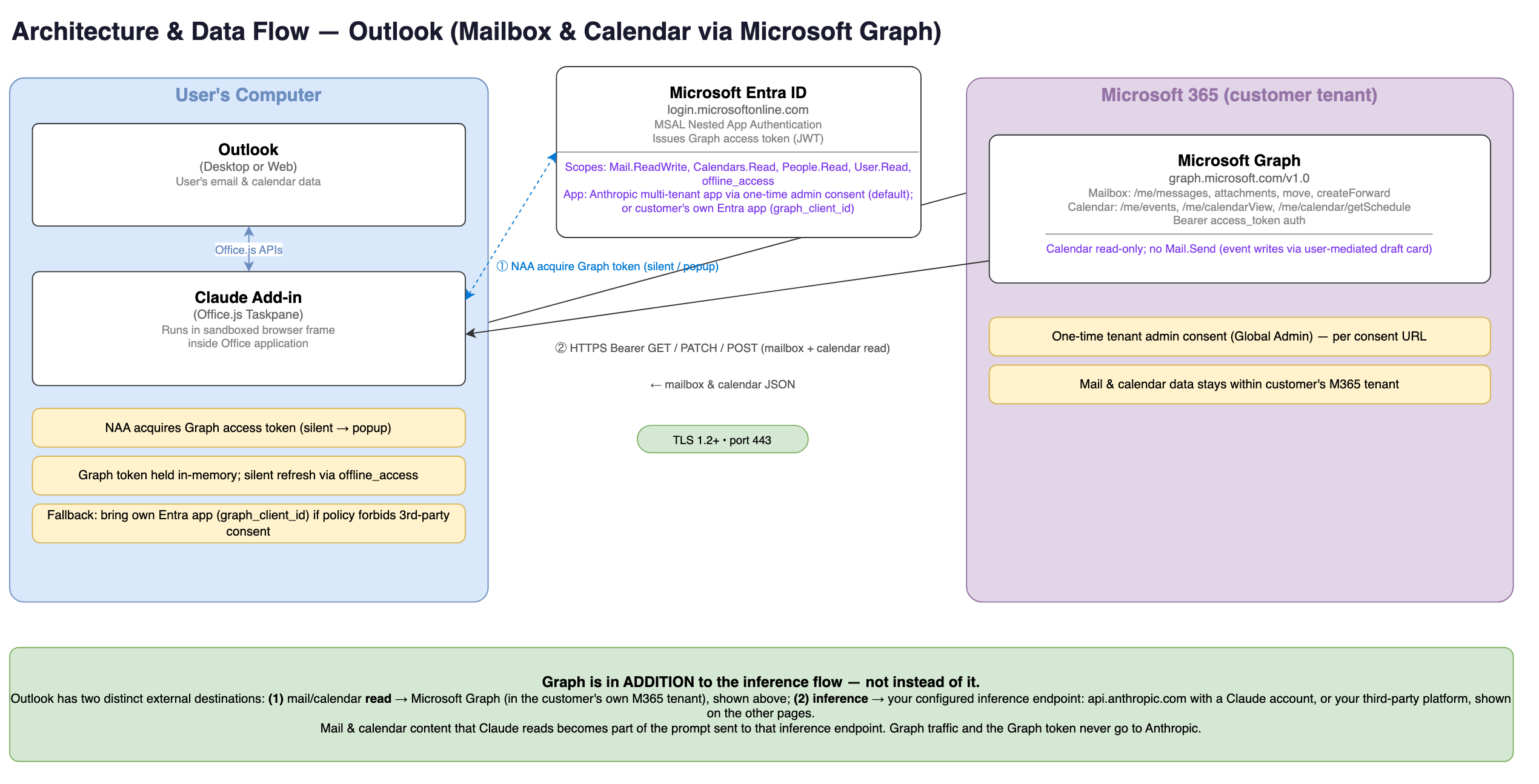
Outlook mailbox access: the open item comes through Office.js, broader mailbox actions use Microsoft Graph, and the Graph token stays in the browser.
When you sign in with a Claude account
Mailbox content that Claude reads becomes part of the prompt sent toapi.anthropic.com. Standard API retention applies: see
Data retention and audit. The add-in does not
keep a server-side copy or index of your mailbox.
When you connect through a third-party platform
The prompt goes only to the inference endpoint you configured, such as Amazon Bedrock, Vertex AI, Azure AI Foundry, or an LLM gateway. On Amazon Bedrock, Vertex AI, or a gateway that routes to them, no mailbox content reaches Anthropic. On Azure AI Foundry, Anthropic operates the Claude models and processes prompts as an independent processor for Microsoft, as described in Claude in Microsoft Foundry. See Use Claude for M365 with third-party platforms for configuration details. The add-in does not keep a server-side copy or index of your mailbox.Chat history
Chat history is stored locally in your browser using IndexedDB. It is not synced across devices or browsers. You can clear all chat history from Settings at any time, which also deletes what Claude has learned about your writing. Signing out of Claude in Outlook deletes both. The local store is also cleared when you clear your browser data. Chat history is specific to the combination of the add-in surface, your user ID, and your organization ID, so your Excel and Outlook histories are separate. Reinstalling the add-in or switching between Claude add-ins does not remove it. See Data storage and retention for where it sits on disk and how long it is kept. When you sign in with a Claude account, the add-in sends your conversations to Anthropic, including the content Claude reads from your mailbox and calendar, and any files you attach. Clearing chat history removes only the copy in your browser. It does not delete the messages or attached files that Anthropic keeps.Data retention and audit
For Claude for Outlook use, inputs and outputs are deleted on Anthropic’s backend within 30 days of receipt or generation, except as described in How long do you store my organization’s data? Enterprise organizations can route full audit telemetry from Claude for Outlook to their own OpenTelemetry collector for integration with a SIEM or observability platform. See Configure a custom OpenTelemetry collector for setup. On Pro, Max, and Team plans, observability and audit export are not available. Claude for Outlook does not inherit custom data retention settings your organization may have configured and is not included in Enterprise audit logs. For Enterprise organizations with the Compliance API enabled, Claude for Outlook sessions are included in the Compliance API. This coverage requires no additional setup: the same Compliance Access Keys apply.Unsupported capabilities
Claude for Outlook does not support the following.- Warnings when you select Send. Claude for Outlook does not use Outlook’s Smart Alerts, so it does not check or hold a message or invite when you select Send. To have a draft checked, ask Claude to review it before you send.
- Shared mailboxes and mailboxes you open as a delegate. Claude for Outlook searches, triages, and moves mail only in your own mailbox.
- Mailbox-wide features without Microsoft Graph consent. Features that look beyond the open email or event, such as search, triage, reading a whole thread, free/busy lookups, and move or flag actions, need Microsoft Graph consent. In an organization, an administrator can grant it once for everyone, as described in Grant Microsoft Graph consent.
Prompt injection risks
Be cautious with email from external or untrusted senders. Email bodies and attachments are untrusted input and may contain instructions intended to manipulate Claude rather than you. Prompt injection refers to malicious instructions hidden in an email body, signature, or attachment that try to trick the AI into taking unintended actions. For example, a routine inbound email might contain hidden text instructing Claude to forward a thread or draft a reply you did not ask for. Claude may interpret these instructions as legitimate requests. Review every draft and inbox action before accepting it, especially when working with email from external or untrusted senders.Current limitations
Claude for Outlook is not recommended for:- Unattended sending. The add-in never sends mail or invites; every draft lands unsent for your review. After you select “Always allow” for a connector, Claude can use it without asking, and some connectors can send.
- Client-facing or counterparty correspondence without reading the draft first.
- Replacing your judgment on which emails matter or how to handle a relationship.
- Mailboxes containing privileged or regulated data without appropriate organizational controls.
Best practices
Follow these guidelines to use Claude for Outlook safely and effectively.- Review drafted replies and invites before sending, especially recipient lists.
- Verify thread summaries against the cited source emails for high-stakes conversations.
- Apply appropriate Microsoft 365 permissions and Conditional Access policies for the add-in.
- Maintain human oversight for anything leaving your organization.
Troubleshooting
Claude cannot search, read attachments, or change an open draft
If only features that look beyond the open email, such as search, triage, and calendar, do not work, mailbox access may not be approved yet. See Grant Microsoft Graph consent. If Claude also cannot read attachments on the open email or change a draft you have open, check the causes below.- An older version of Chrome or Microsoft Edge in Outlook on the web: at version 137 or earlier, these features may not work. Update the browser to the latest version, then restart it. If you cannot update it, ask your IT administrator.
- An older WebView2 Runtime in Outlook on Windows: Outlook on Windows shows add-ins in the Microsoft Edge WebView2 Runtime, and at version 137 or earlier these features may not work. The runtime updates itself by default, separately from Outlook and Microsoft 365 updates. If it is out of date, your organization may manage its updates. Ask your IT administrator to update it to the latest version, then restart Outlook. See Microsoft’s guidance on WebView2 and Microsoft 365 Apps.
- A content blocker: some content blockers, such as ad blockers, have the same effect, even in a current browser. Turn off the content blocker, then reload the page or restart Outlook, and try again.