1. Set up
Try a plugin
The Sales plugin ships with /pipeline-review and other forecast-hygiene skills as a starting point, already structured to score opps and call out risk. If your admin manages plugins and it's not available yet, skip this; nothing below requires it.
Connect your tools
Claude Cowork is more powerful when it works directly with your systems. You control permissions and access. Learn about tool access(opens in new tab).
Navigate to Customize → Connectors in Cowork to set up.


Set your working folder
Drag the files you'll use (this week's pipeline export, last week's review doc, your stage definitions) into one folder on your machine, then point Cowork at it. Cowork reads from it and writes the scored sheet and review doc back to it. If you run pipeline weekly, create a Cowork project(opens in new tab) from that folder so your stage criteria, instructions, and memory stay attached.
2. The prompt
Copy this into Claude Cowork
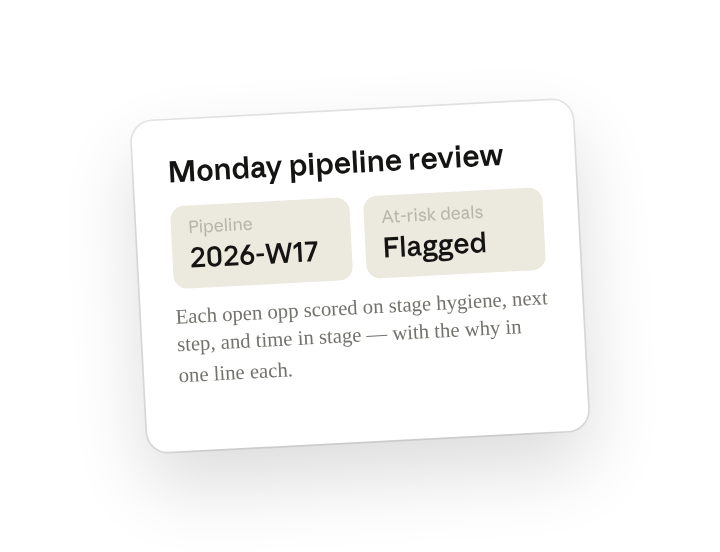
Score each open opp in this week's pipeline on stage hygiene, whether there's a real next step, and how long it's sat in stage. Flag the at-risk deals and say why in one line each, then write the manager-ready review doc for our Monday pipeline meeting.
Why this works
Spell out your scoring criteria. "Hygiene, real next step, age in stage" gives Cowork the rubric your manager uses, so the score means something in the meeting instead of being a generic health number.
Set a length limit per item. "Say why in one line each" keeps the at-risk section scannable, so the meeting time goes to the deals that need it rather than reading paragraphs.
Ask for the write-up alongside the data. "Manager-ready review doc" tells Cowork to write the narrative around the scores, the part you'd otherwise type up Sunday night.
Put your reference docs in the folder. Your stage exit criteria and last week's review doc sit in the working folder, so hygiene is scored against your definitions and the doc follows the format your manager already expects.
Get a better draft
Add an example to match. Drop an example you like into the folder and Cowork matches your structure and voice.
Ask it to flag uncertainty. Add "flag anything you're not confident about" so you know where to look first when you review the draft.
3. Make Cowork work for you
A plugin skill is a starting point — customize it with your own practices and expertise. A few minutes of conversation and it runs with your standards from then on.
Make what we've done in this task so far into a skill, or edit the /pipeline-review skill with my feedback.
4. Make it repeatable
Run it before the Monday meeting
The review should be waiting before the meeting, not built during it. Type /schedule in the prompt, or open Scheduled in the Cowork sidebar, and the customized skill scores the pipeline and writes the doc every Monday morning.
/schedule Every Monday at 8am, run /pipeline-review against the current Salesforce pipeline and write the scored sheet and review doc to a new folder under Pipeline named for the week.
Runs /pipeline-review against the current Salesforce pipeline and writes
the scored sheet and review doc to a weekly folder.
5. Share with your teammates
Your customized /pipeline-review now carries your stage criteria, your at-risk thresholds, and your review doc format. Share it so every rep scores their own pipeline the same way, and the team meeting reads from one consistent doc per rep.