1. Describe the task
Claude can read through hundreds of deal notes and identify recurring themes in minutes. Using your strategic insight and refinement, you can create several competitive intelligence battlecards that reveal larger patterns and live in one spot.
Ask Claude to create a competitive dashboard for multiple competitors, with individual battlecards featuring specific talk tracks, objection handling scripts, and positioning strategies, all based on relevant information from your CRM and competitive intelligence sources.
Pull the closed-lost deals in our CRM from the last 6 months where DataGuard, BackupPro, or SecureVault appear in the competitor field. Read the deal notes for each competitor and tell me what patterns you see for each one. Search the web for their websites, G2 reviews, and recent positioning to find additional information.
Then, build a React-based competitive intelligence dashboard with a list view showing all three competitors and detailed battlecards for each. Build it like a modern analytics dashboard - clean, flat, metric-dense, with that tech meets creative minimalism. Think calculator app but for competitive intelligence.
2. Give Claude context
Claude needs details about your product, your competitor, and your typical sales scenarios to create battlecards that reflect real selling situations.
Required context
Connect your CRM, like HubSpot(opens in new tab) or Salesforce(opens in new tab), so Claude can pull your closed-lost deals automatically.
Make sure Web Search(opens in new tab) is turned on so Claude can research competitor sites and reviews.
Upload a screenshot of your website or sales materials if you want the battlecard to match your brand's colors and fonts.

3. What Claude creates
Claude produces a comprehensive battlecard structured for quick reference during sales calls, including competitive positioning, differentiation strategies, objection handling scripts, and proven talk tracks that help sales teams win more competitive deals.
I've created a competitive intelligence dashboard tracking DataGuard, BackupPro, and SecureVault based on your CRM data and competitive research.
Overview page:
- Competitor cards - Each competitor shows their win rate, trend direction, average deal size, and sales cycle at a glance
- Pattern detection - Highlighted key patterns like "Security hooks early, decisions turn on 'more customers' + 'too simple'" with frequency data
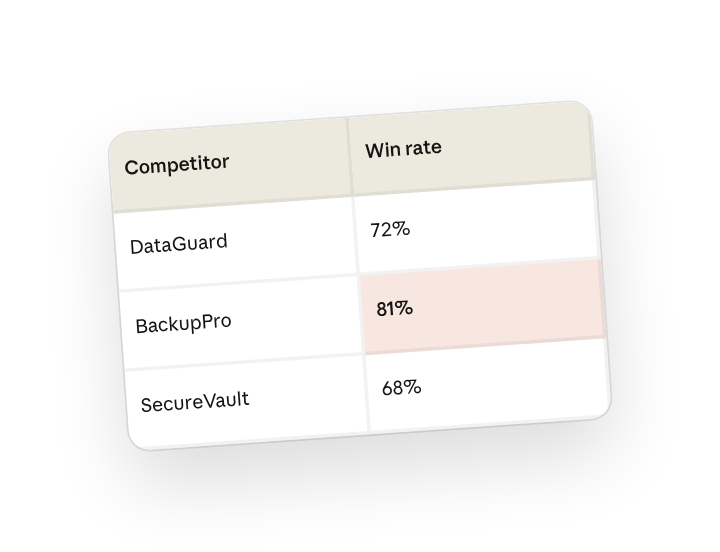
- Comparative metrics - See your win rate against each competitor side-by-side (72% vs DataGuard, 81% vs BackupPro, 68% vs SecureVault)
Center content - Tabbed sections:
- Vulnerabilities - Three major weak points with specific ask questions: "Show me day-one deployment" exposes their 12-week implementation gap
- Talk tracks - Power positioning with exact wording: "DataGuard confuses complexity with sophistication. Apple secures 2 billion devices with one button."
- Discovery questions - Trap questions in grid format: "Can you restore files in-app?" forces them to admit they'll send an engineer
- Objections - Common objections you'll hear → what to say → proof points to reference
- Positioning - How to reframe their claims: "enterprise-grade" → operational excellence, "military security" → recovery speed
Right sidebar:
- Red flags - When to walk away from a deal (no timeline, purely feature-driven decisions, zero incumbent dissatisfaction).
- Win metrics - Your success rates when using the battlecard (72% win rate, 2.4× faster close, $147K average won deal)
4. Follow up prompts
Continue the conversation with Claude to refine, expand, or explore further.
Generate training scenarios
Use the competitive intelligence to create realistic role-play scenarios for new sales team members, pulling from actual objections in your loss data.
Create three realistic sales call scenarios using actual objections from our BackupPro losses. Include the objection, our response, and likely follow-up questions.
Analyze competitive trends over time
Claude can track how competitor positioning changes quarter over quarter, helping you anticipate their next moves and adjust your strategy.
Compare our current DataGuard intelligence to the battlecard from Q2. What has changed in their positioning, and should we update our counter-messaging?
5. Tricks, tips, and troubleshooting
Combine multiple data sources for better intelligence
Connect your CRM for sales data, Google Drive for competitive research documents, and Slack for team discussions about competitor challenges. Claude finds patterns across all three sources, creating richer battlecards with more context. For example, if your Slack #sales channel mentions DataGuard's implementation delays and your CRM notes confirm it, Claude will emphasize that vulnerability.
Always verify specific facts before sharing
Claude excels at identifying patterns in your deal notes and synthesizing information across competitors. However, if the battlecard contains specific competitor pricing, feature launch dates, or customer names, always double-check those details. Instruct Claude to include citations and reference links for easy verification.
6. Ready to try for yourself?
Equip your sales team with unified competitive intelligence. Work with Claude to synthesize your market knowledge across multiple competitors into a dashboard that helps you close more deals.