Set up
Try a plugin
The Data plugin ships with /write-query and other warehouse-and-BI skills as a starting point, already structured to read a data model and write queries against it. If your admin manages plugins and it's not available yet, skip this step. The prompt below works without it.
/write-queryWrite SQL for your warehouse's dialect from a plain-language question, then offer to run it/explore-dataProfile a table and summarize what's in itConnect your tools
Claude is more powerful when it works directly with your systems. You control permissions and access. Learn about tool access(opens in new tab).
Add a connector(opens in new tab) for each tool you want Claude to use.


Set your working folder
Drag the files you'll use (your schema export or dbt models, your metrics library, your data dictionary) into one folder and give Claude access to it(opens in new tab) in the Claude desktop app. Claude reads the model from there and writes the SQL, the result table, and the answer memo back to it. If you field ad-hoc questions regularly, create a project(opens in new tab) from that folder so your naming conventions and certified-metric list stay attached.
The prompt
Copy this into Claude
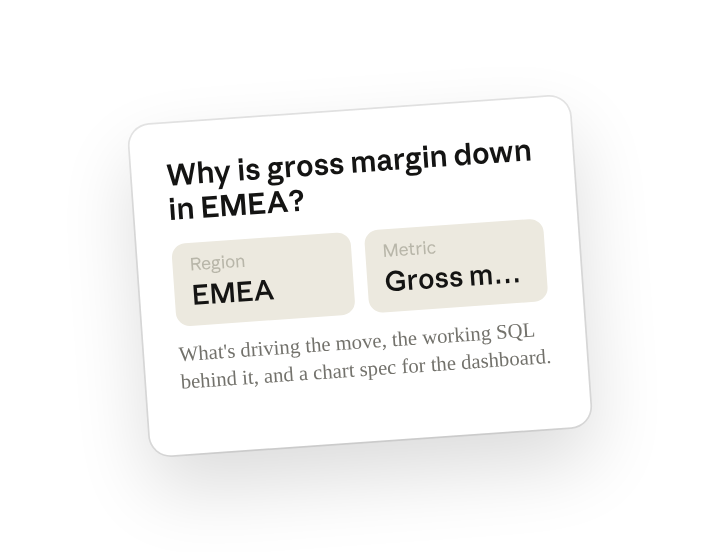
Here's the question from the business: "Why is gross margin down in EMEA this quarter?" Write the SQL to answer it, run it against the warehouse, and tell me what's driving the move. Then give me the chart spec to add to the dashboard so nobody has to ask again.
Why this works
Paste the question verbatim. Using their exact words keeps the answer aimed at what they asked, in the terms they used.
Ask for what's driving the number. "What's driving the move" is asking for the breakdown behind the number: which segment, which change, which date.
Ask for a reusable output. "Chart spec to add to the dashboard" is asking for something the asker can refresh themselves next time.
Let the working folder supply context. SQL is written against your tables and your metric names, not invented ones.
Get a better draft
Add an example to match. Drop an example you like into the folder and Claude matches your structure and voice.
Ask it to flag uncertainty. Add "flag anything you're not confident about" so you know where to look first when you review the draft.
Make Claude work for you
Tell Claude your own preferences for this task, such as your naming rules and your answer format, then save what you've done as a skill of your own. A few minutes of conversation and it runs with your standards from then on.
Make what we've done in this task so far into a skill called /adhoc-answer.
Review the skill, and save it if Claude hasn't already.
Make it repeatable
Run it on every inbound question
The ad-hoc queue never stops. Ask Claude to set up a scheduled task, or open Scheduled in the sidebar, and /adhoc-answer runs on new questions in your analytics-requests channel and drafts the query and answer before you've even read the message.
Set up a scheduled task that runs every hour on weekdays: check #analytics-requests in Teams for new questions, run /adhoc-answer on each one, and write the draft answer to Analytics/Inbox/<thread-id>.md for me to review before it goes back.
Hourly, reads new questions in #analytics-requests, runs /adhoc-answer against the warehouse, and writes a draft answer for review.
To use a folder on your computer during a scheduled task, keep your computer on and awake with the Claude desktop app open so Claude can access it.
Share with your teammates
Your /adhoc-answer skill now carries your warehouse model, your certified metrics, and your answer format. Share it so every analyst writes SQL against the same definitions, and the business gets the same number no matter who they ask.